
Somerset County City Directory Collections
The strongest local run is centered on Somerville. The Somerset County Library System of New Jersey, known as SCLSNJ, describes Somerville directories arranged by name from 1851 through 1933 and by ward, precinct, and address from 1939 forward. Bridgewater holds a documented 1917 to 1984 print and microfilm run. Those arrangements matter: an early search begins with a surname, while many later volumes can begin with an address. The county is broader than the shelf label, so a move into Plainfield, New Brunswick, Bound Brook, Raritan, or Bridgewater may call for a regional volume too.
| Collection | Years | Where held | Access |
|---|---|---|---|
| Somerville directories | 1851-1933; 1939-present | SCLSNJ Somerville and Bridgewater local history | In person; some digital links |
| Bridgewater directory run | 1917-1984 | SCLSNJ Bridgewater | Print and microfilm |
| Somerville poll-tax directories | 1887-1938 | SCLSNJ local-history room | Microfilm |
| Telephone directories | 1911-present, with gaps | SCLSNJ local-history room | Paper and microfilm |
| Boyd's combined directory | 1885-1886 | Library and digitized holdings | Availability varies |
Publisher names should come from the title page, not assumption. The official local-history descriptions do not identify every imprint. The New Jersey State Library finding list does identify Richmond's Somerville and Bound Brook Directory and a 1980 Somerville volume that includes Bound Brook, South Bound Brook, Raritan, and Bridgewater Township.
Earlier local material has another access path. SCLSNJ's Somerville collection points to online material from 1869 through 1919, although the arrangement depends on the volume. Library databases can add digitized volumes and newspaper tools, but their access conditions are license dependent. Ancestry Library is branch-only, while HeritageQuest, HeritageHub, Fold3 Library Edition, historical newspapers, and New Jersey newspaper collections may be available through the library's resources. Record the database, title, year, page, and image when copying a result. A database index is a lead, not a substitute for the scanned page.
Regional shelves can solve a move that appears to leave Somerset. Bridgewater lists Plainfield volumes from 1902 through 1982 and New Brunswick volumes from 1968 through 1987. Boyd's 1885 to 1886 combined volume joins Plainfield, Somerville, Bound Brook, Raritan, Dunellen, Westfield, and Fanwood. Check the postal place and municipality separately before treating a nearby listing as the same household.
Somerset County Directory Years
Somerville's changes in arrangement are a local records story. The 1851 through 1933 volumes are name-organized. The 1939 to present description adds ward, precinct, and address organization. That later format can connect a known house number to a household, while the earlier format needs a likely name first. Catalog listings also identify Somerville volumes for 1949, 1954, and 1959, although the official SCLSNJ description does not supply their publisher imprint.
- 1851-1933: Start with the alphabetical name arrangement and copy initials exactly.
- 1887-1938: Use the poll-tax microfilm as a separate ward, precinct, and street-address layer.
- 1911 forward: Compare telephone directories, recognizing that some years are missing.
- 1939 forward: Check ward, precinct, and address organization alongside the name search.
Note: A gap may reflect an omitted year, a move, a coverage boundary, or a change in how the volume was organized.
Somerset County Poll-Tax Directories
The 1887 to 1938 Somerville poll-tax directories are a distinctive address layer. They are arranged by ward and precinct, then by street address, so they can help place a named person near a particular house. Before 1920, however, they list only men. They are not a full census of the people who lived on a block. Treat them as a focused historical roll, then compare the result with a historical volume, census, newspaper, or deed records.
That limitation can be useful rather than frustrating. If a household appears in a city directory but not in the poll-tax file, the difference may point to eligibility, household role, or the collection's coverage rather than a mistaken address. Preserve the ward, precinct, volume year, and page when making the comparison. Those details make a later visit to the local-history room much easier to repeat.
Reading Somerset County City Directory Entries
A Somerset County historical entry can contain a surname, given name or initials, street and number, occupation, employer, a spouse or widow notation, and sometimes a telephone or business classification. The official collection description does not reproduce a sample page, so the printed abbreviation key in the exact volume is the authority. Record the page and year with every extract. Do not expand a mark by guess, especially when an entry uses a short form for an address or household status.
| Printed name | Copy the surname, initials, and given name exactly as printed. |
|---|---|
| Family notation | Note any spouse or widow wording without trying to infer more than the volume says. |
| Address | Capture the street, number, ward or precinct when present, and the volume year. |
| Work or business line | Record an occupation, employer, proprietor line, or classification only when it appears. |
| Telephone or key | Keep any number and photograph or transcribe the volume's abbreviation key. |
- Criss-cross directory
- An address-ordered section that groups entries by street and number when the volume provides one.
- Householder index
- A name list focused on the person identified with a household, not a complete list of everyone there.
- Abbreviation key
- The volume's own explanation of its shortened forms. Read it before interpreting an entry.
Somerset County Directory Shelf
SCLSNJ Local History and Genealogy is the practical starting point for the Somerset County directory shelf. Its licensed resources include branch-only Ancestry Library, HeritageQuest, obituary and newspaper tools, and local collections. Bridgewater also lists directory, map, clipping, and newspaper microfilm holdings. Library-license conditions vary, so a database index should be treated as a pointer until the underlying page or image is checked.
The SCLSNJ local-history collection is the source for the directory holdings shown here.
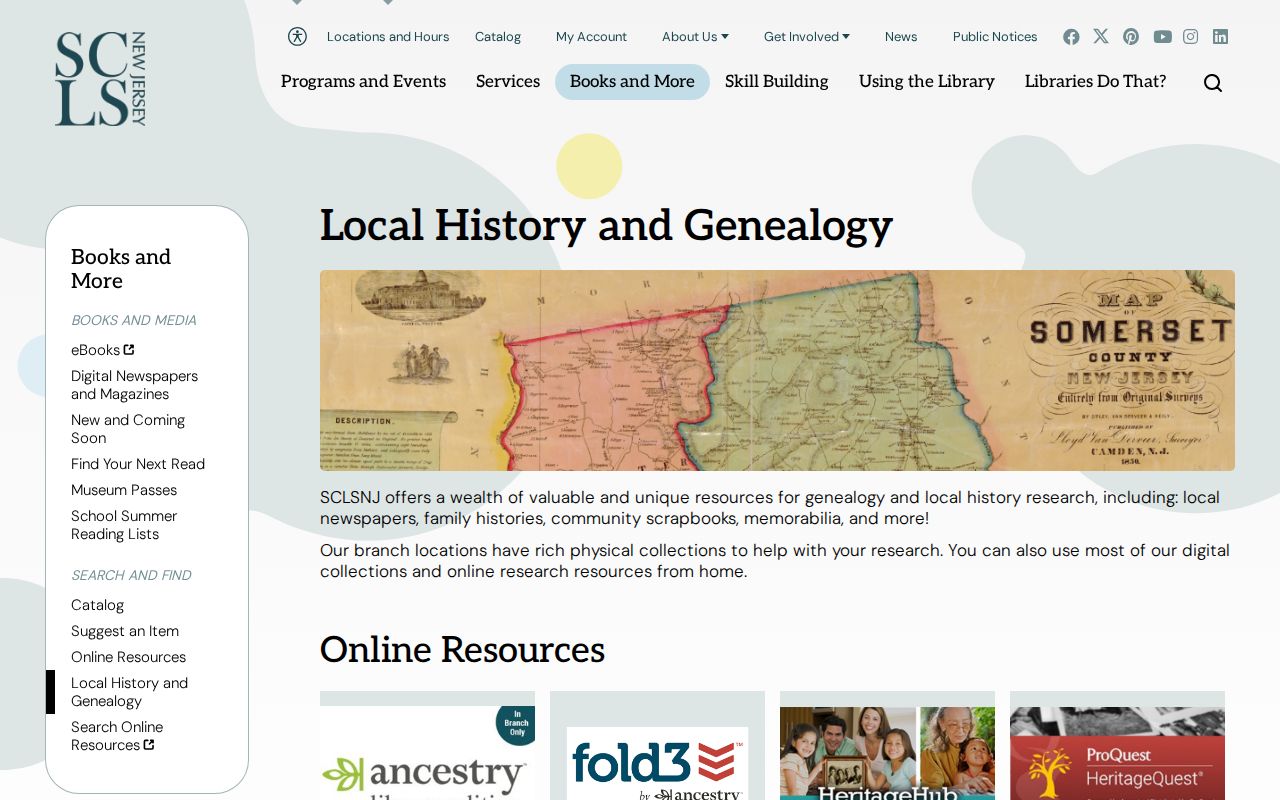
Use the shelf details to decide whether a name, address, newspaper, or map is the better next source for a Somerset County search.
For deeper manuscript research, the Somerset County Historical Society collections at the Van Horne Library include more than 1,300 bound volumes, more than 400 family files, maps, microfilm, photographs, and processed legacy material with early deeds and land records. The library's stated hours are Tuesday 11 to 3 and the second and fourth Saturdays noon to 3.
The Historical Society's collections page documents the Van Horne Library holdings.
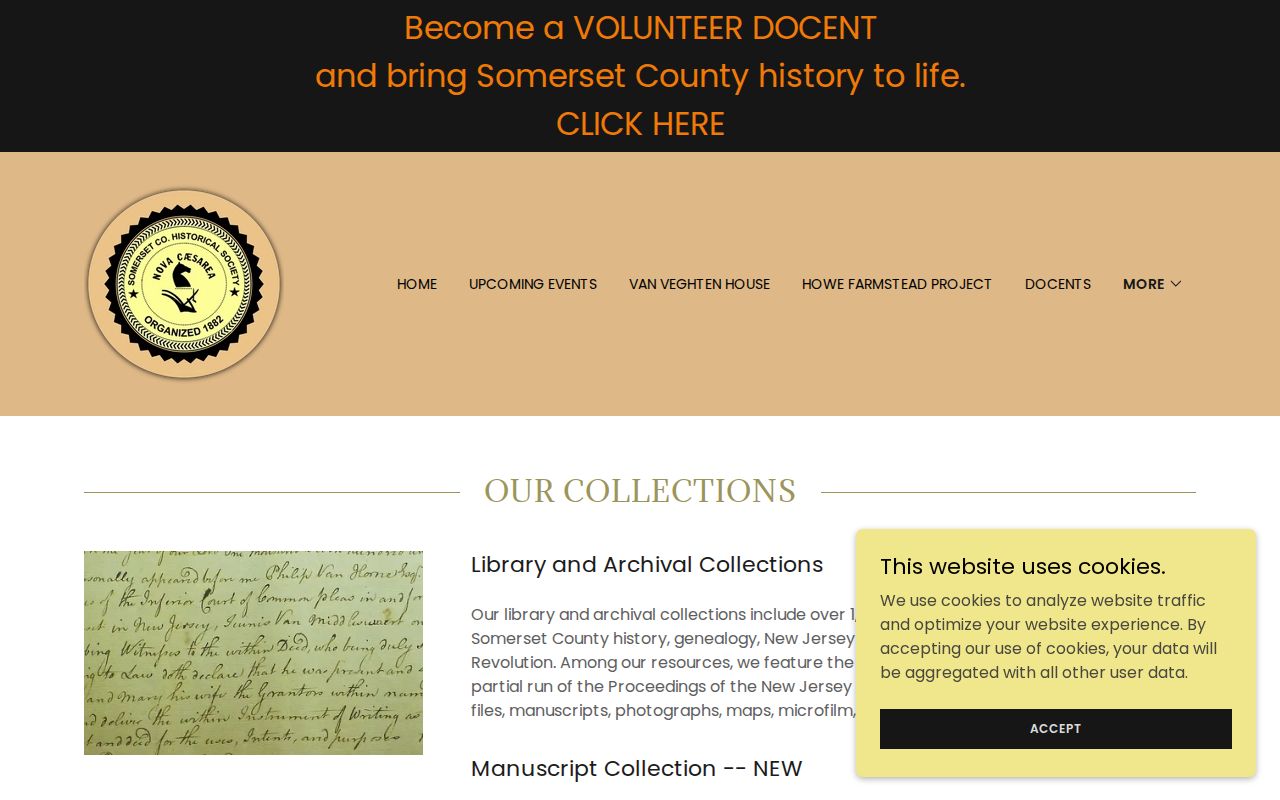
Those family files and maps can help test a directory lead, but they should be cited as collection material rather than treated as current-residence proof.
Somerset County Directory Maps
Pair a directory address with the 1917 Somerville Sanborn map when the question is how a place looked at that time. The public-domain map can show building footprints, materials, stories, street names, and nearby structures. It is not an ownership list. The local-history collection also notes historic atlases and maps, which can help when a street name or neighborhood label shifts between sources.
Newspapers provide a second companion layer. SCLSNJ lists Somerville Journal microfilm from 1876 forward and a searchable Messenger-Gazette obituary index for 1986 to 2012. An obituary index needs an image or microfilm check before it is cited. Keep the title, date, page, and database name, since a short index result is not the original notice.
Tracing Somerset County City Directories
Use a city directory as a sequence, not as a one-year verdict. Begin with the first plausible household and move one edition at a time, copying the address, initials, family notation, and any business line. Then test the same address against census schedules. Federal census access follows the 72-year release rule, and the Somerville local-history room lists 1790 to 1910 microfilm plus 1790 to 1940 online Ancestry access. Publication and enumeration dates differ, so a small mismatch can be real.
- Find a person in the name-organized run or an address in a later ward-and-precinct volume.
- Copy the entry exactly, including spelling, initials, address, and the volume year.
- Check the editions immediately before and after it for a move, a new widow note, or a changed household line.
- Pair the closest directory year with a released federal census household.
- Use a newspaper obituary, probate file, or cemetery source to test an apparent ending in the trail.
A directory can identify an occupant even where a deed identifies a different owner. For a current parcel record or a full deed chain, use the address-focused Somerset County street directory rather than trying to make a historical volume answer a modern property question.
Somerset County Digitization Initiative
Somerset County posted a 2025 document titled Historical Document Restoration and Digitization for Somerset County, contract CC-9095-25. The public item indicates an active preservation effort, but the inspected material does not identify which record series, schedule, or public release date will result. That uncertainty is important. A preservation contract is not a promise that a particular city directory or deed volume is searchable online today.
The deeper record setting is layered. Somerset County was set off from Middlesex County on May 14, 1688. The State Archives holds deed microfilm through 1900, county mortgages through 1850, Common Pleas naturalizations from 1805 to 1922, and Surrogate material that reaches into the early nineteenth century. Those series can test a name or address found in a historical volume, particularly when a directory begins after the event being researched. They should be treated as separate record groups with their own access rules, dates, and indexing practices.
The Somerset County Historical Society research-service information is a useful fallback for a focused historical question. Its stated service is $30 for up to two hours, typically five to eight weeks, with a detailed request that supplies names, dates, places, contact details, and payment. The research-service page is shown here.
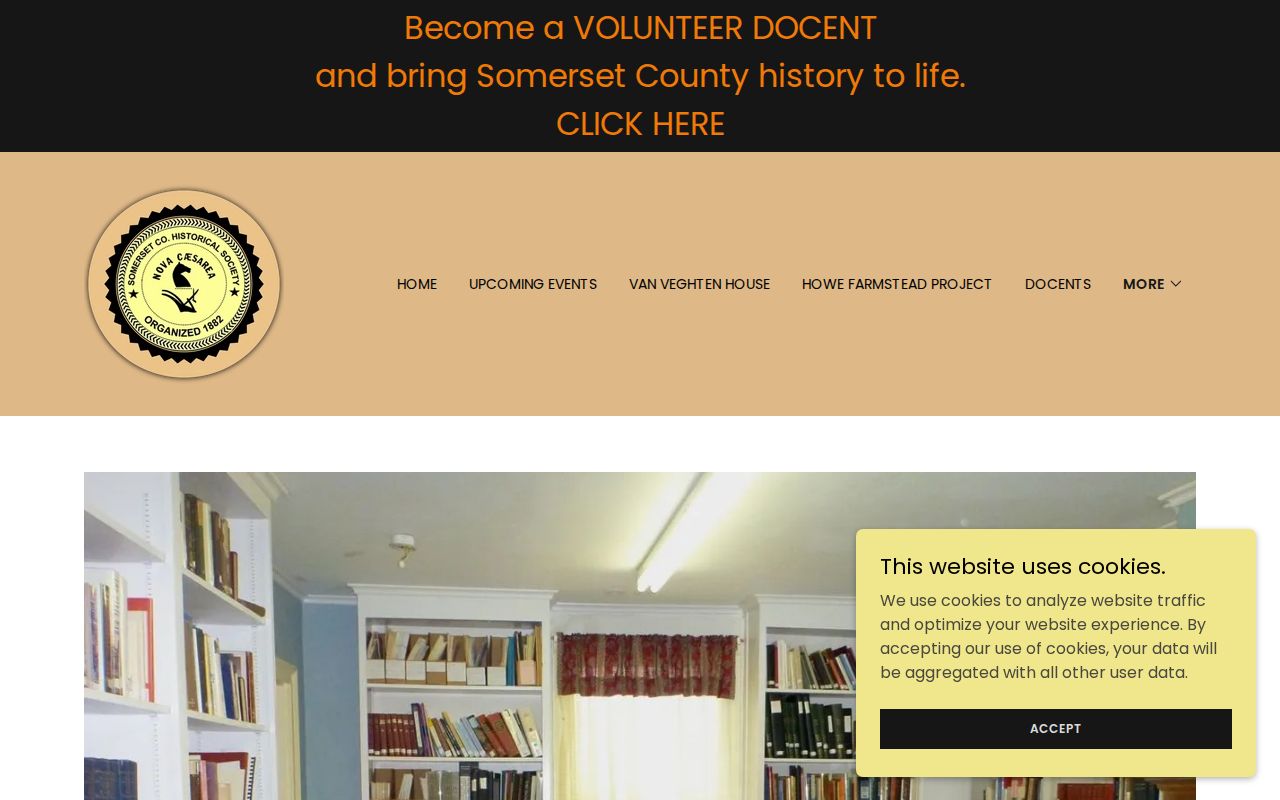
For a difficult directory gap, a specific request for an address, approximate date, and known surname is more useful than a broad request for every record connected to a property.